1. Set up the business
Most guarding firms are limited companies: you register with Companies House online, register for Corporation Tax and set up PAYE as an employer before you pay anyone. Register for VAT once your taxable turnover passes £90,000 in a rolling 12 months (or earlier if your clients are VAT registered and you want to reclaim VAT on costs).
2. Licences: yours as well as your guards'
Every guard doing licensable work needs the right front-line SIA licence: Security Guarding, Door Supervision, CCTV (Public Space Surveillance) or Close Protection. A licence costs £204 and lasts three years. Directors, managers and supervisors of licensable staff need a non-front line SIA licence if they don't hold a front-line one. Supplying unlicensed staff is a criminal offence for the company as well as the guard.
3. Insurance
- Employers' liability: a legal requirement once you employ anyone, with at least £5 million cover
- Public liability: clients will ask for it, often £5–10 million
- Professional indemnity and contract works cover, if contracts require them
- Most insurers ask about vetting (BS 7858), training and how you check on lone workers
4. Vetting, training and policies
Clients and insurers expect screening to BS 7858 (identity, five-year history, right to work and criminal record checks). Write down how you assign shifts, handle lone working, incidents, complaints and data protection. You'll need these for tenders and, later, for the ACS.
5. Price your contracts properly
The charge rate has to cover far more than the guard's pay: employer National Insurance, pension, holiday, licences, uniform, insurance, supervision and margin. At £12.71 an hour minimum pay, a sustainable charge rate is usually well above £18. Work yours out with the charge rate calculator and read how to price guarding contracts.
6. Win the first contract
First contracts usually come from local businesses, events and subcontracting for bigger firms. Respond quickly, show licences and insurance up front, and offer something larger firms often don't: a named contact and live proof of cover.
7. The Approved Contractor Scheme (ACS)
The ACS is the SIA's voluntary quality standard. It isn't required by law, but many larger clients and public bodies ask for it in tenders. You need a track record and documented processes, and you're assessed against the scheme's standards by an approved body.
8. Systems from day one
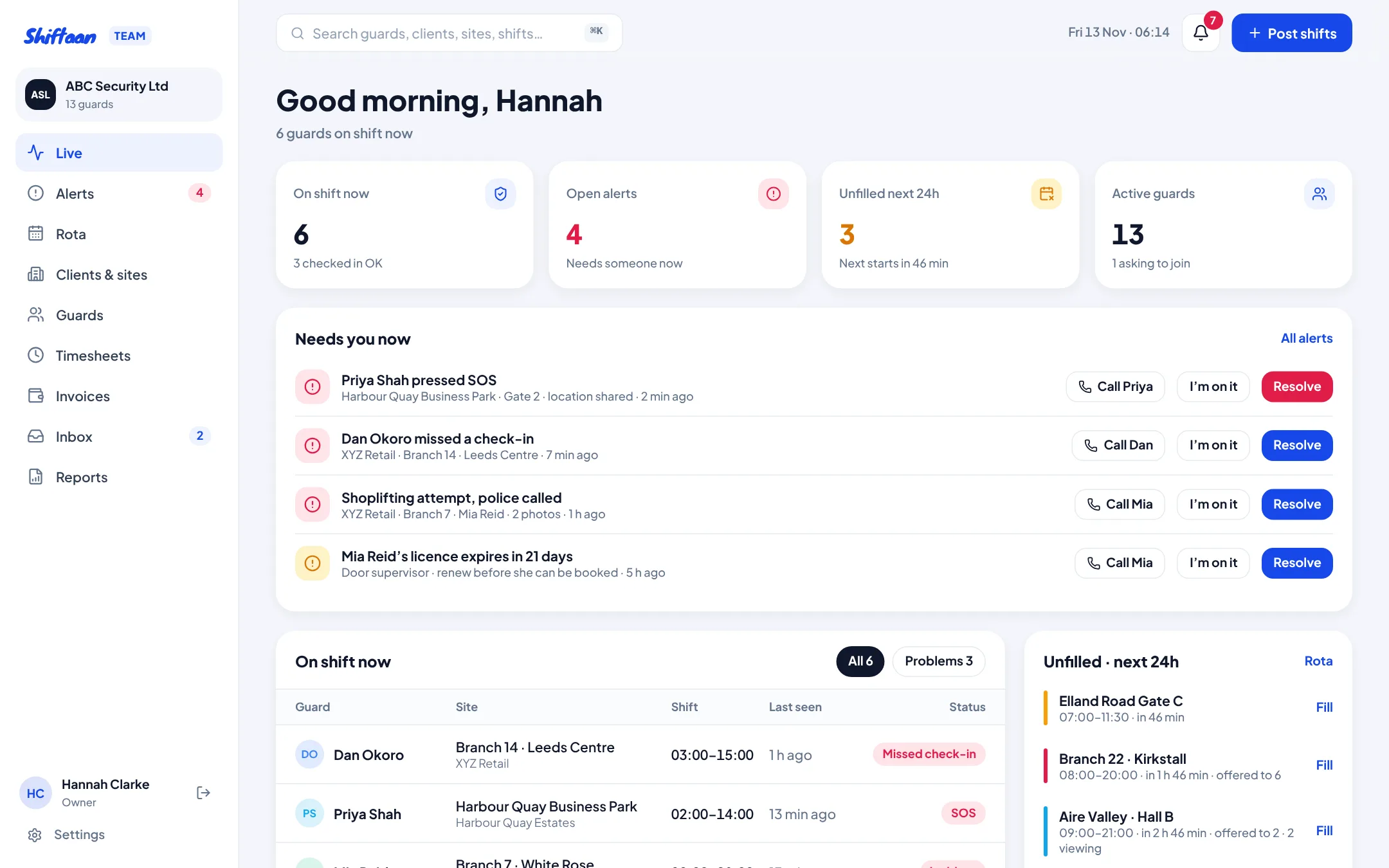
Starting on a spreadsheet and a WhatsApp group is normal. The trouble starts with your third client: rota mistakes, missed check calls and timesheets that don't match invoices. A system like Shiftaan Team keeps the rota, check-ins, timesheets and invoices in one place from the start.
Common questions
Do I need an SIA licence to run a security company?
If you direct or manage people doing licensable work and you don't hold a front-line licence, you need a non-front line SIA licence. Your guards each need the right front-line licence.
Is ACS approval required?
No, it's voluntary. But it's often a requirement in larger tenders, so plan for it once you have a track record.
How much does it cost to start?
The main early costs are insurance, licences, uniforms, a website and working capital: you pay guards weekly or monthly, but clients often pay on 30-day terms.